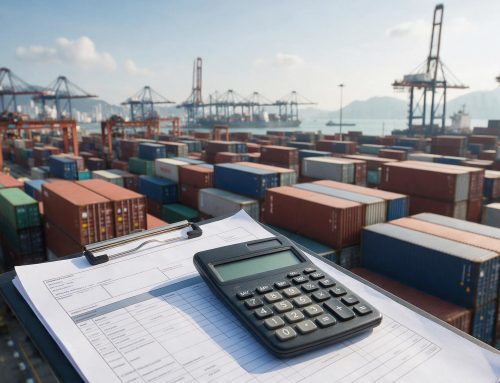

From the container yards of Kwai Tsing to the trading offices lining Tsim Sha Tsui and Central, Hong Kong’s merchandise trade sector moved a record HK$9,465 billion worth of goods in the most recent full year on record, and momentum has only accelerated since. Import-export trading remains one of Hong Kong’s four core economic pillars, contributing around 14.4% of GDP and employing roughly 401,000 people across more than 95,000 trading establishments citywide. For a business operating at this scale and speed, accounting cannot be an afterthought — it is the difference between a company that knows its real margins and one that is flying blind on thin spreads, multi-currency settlements, and IRD scrutiny.
This guide walks through what trading company accounting in Hong Kong actually requires: the bookkeeping foundations, the stock and inventory rules specific to goods-based businesses, and the cash flow disciplines that keep a trading operation solvent between purchase and payment.
Bookkeeping Foundations for HK Trading Firms
Every company carrying on trade in Hong Kong is legally required to keep records that correctly explain all transactions and allow its financial position to be determined at any time, under the Companies Ordinance. Separately, the Inland Revenue Ordinance requires anyone carrying on a trade or business in Hong Kong to retain sufficient records — in English or Chinese — for a minimum of seven years, with failure to comply carrying a fine of up to HK$100,000.
For a trading company, “sufficient records” goes well beyond a simple cash book. The IRD specifically expects businesses dealing in goods to maintain:
- A day-by-day record of all money received and paid, tied to supporting invoices and receipts
- Detailed records of goods purchased and sold, identifying sellers, buyers, quantities and values
- Statements of trading stock held at each accounting period end, plus the stock-take records used to prepare them
- Bank statements, contracts, shipping and customs documentation, and payroll/MPF records
| Bookkeeping Component | What It Tracks | Why Trading Companies Need It |
| Sales ledger (AR) | Customer invoices, due dates, currency, balances | Multi-currency exposure (HKD, USD, RMB) needs constant reconciliation |
| Purchase ledger (AP) | Supplier bills, landed costs, prepayments | Links directly to cost of goods sold and margin accuracy |
| Inventory sub-ledger | SKU, quantity, unit cost, warehouse location | Core input for trading stock valuation and IRD stock statements |
| Cash book & bank reconciliation | Daily cash movements against bank balance | Required day-by-day under IRD record-keeping rules |
| Fixed asset register | Depreciation, disposals, warehouse equipment | Supports audited accounts and tax allowances |
A practical monthly close cycle — reconciling bank accounts, updating debtor and creditor ledgers, and checking stock movements — is what separates a trading company that sails through its annual audit from one that spends weeks reconstructing a year of transactions after the fact. Our bookkeeping and accounting services are built around this monthly discipline specifically for goods-trading businesses, so your books stay audit-ready year-round rather than becoming a year-end scramble.

Stock Valuation Rules Every Trader Must Know
Trading stock sits at the heart of a trading company’s tax position, because it directly drives assessable profit under Hong Kong’s Profits Tax regime. The IRD’s Departmental Interpretation and Practice Notes set out clear expectations for how stock is valued and reported.
Key rules to follow:
- Valuation basis — opening and closing stock should be valued at the lower of cost and net realisable value
- Consistency — whichever valuation method is used must be applied consistently year after year; switching methods to manage tax outcomes invites IRD scrutiny
- Documentation — every stock statement must be backed by actual stock-take records, not estimates
- Landed cost capture — cost of goods should include purchase price plus freight, insurance, duties and handling, not just the invoice price
| Stock Record Type | Content Required | Compliance Purpose |
| Stock cards / perpetual inventory | SKU, quantity on hand, unit cost, location | Foundation for year-end trading stock statement |
| Physical stock-take sheets | Counts by location and date, variances vs. book | Required evidence behind the stock statement IRD may request |
| Costing sheets | Landed cost per shipment/batch | Ensures accurate cost of goods sold and margin reporting |
| Aging reports | Stock grouped by age (0-30, 31-90, 91+ days) | Identifies slow-moving stock relevant to net realisable value adjustments |
Given that Hong Kong’s offshore merchanting trade — buying and selling goods that never physically enter the city — runs into the hundreds of billions of dollars annually with reported gross margins around just 5.5%, precision in stock and cost accounting isn’t optional. A small error in landed cost allocation can wipe out a meaningful share of already-thin trading margins. This is exactly where structured bookkeeping support pays for itself, catching costing errors before they distort your reported profit.
Cash Flow Management for High-Volume Traders
Hong Kong’s total exports of goods climbed 15.4% year-on-year to a record HK$5,240.3 billion recently, with imports rising 15.5% over the same period. That kind of volume growth is good news for revenue — but it also multiplies the cash flow strain on trading companies that must pay suppliers, cover freight and duties, and manage payroll long before customer payments land.
Trading companies typically face a cash conversion gap: cash goes out for stock, shipping and staff weeks or months before it comes back in from customers. Managing that gap requires structured forecasting and tight working-capital discipline, not guesswork.
Core cash flow tools for trading companies:
- Rolling 13-week cash flow forecast — projecting weekly inflows from customers against outflows for suppliers, freight, payroll and tax provisions
- AR/AP aging analysis — flagging overdue customer balances and concentrated supplier payment risk before they become crises
- Working capital KPIs — tracking Days Sales Outstanding, Days Payable Outstanding and Days Inventory Outstanding to see exactly how much cash is tied up in stock and credit terms
- Tax reserve planning — setting aside provisions for Profits Tax (8.25% on the first HK$2 million of assessable profits, 16.5% above that for corporations) so a tax bill never catches the business short on cash
| Cash Flow Metric | What It Measures | Trading Company Relevance |
| Days Sales Outstanding (DSO) | Average time to collect from customers | Longer DSO means more cash locked up in receivables |
| Days Payable Outstanding (DPO) | Average time to pay suppliers | Higher DPO improves short-term liquidity, if managed carefully |
| Days Inventory Outstanding (DIO) | Average time stock sits before sale | High DIO signals cash trapped in slow-moving goods |
| Cash conversion cycle | DSO + DIO − DPO | Shorter cycle means faster cash recovery per trade |
Because payroll is one of the most predictable and unavoidable cash outflows every month, getting it right and on time protects supplier and staff relationships even when customer payments run late. Our payroll services handle monthly processing, MPF contributions and IR56 filings so that payroll never becomes an unexpected cash flow shock.
Staying Audit-Ready and Compliant Year-Round
Every Hong Kong company, aside from those formally dormant, must undergo an annual statutory audit of its financial statements, and directors who fail to ensure compliance with record-keeping obligations can face fines of up to HK$300,000. For trading companies with high transaction volumes across multiple currencies and suppliers, audit preparation genuinely needs to start well before year-end.
A practical audit-readiness checklist for trading companies:
- Reconcile bank statements against the cash book monthly, not annually
- Match every supplier and customer invoice to its corresponding payment
- Complete a full physical stock-take before the financial year-end and file the results
- Confirm your annual return and Business Registration renewal deadlines are tracked and met
- Review your corporate structure and shareholder records for accuracy ahead of the audit
Our audit arrangement service coordinates directly with your appointed auditor to close out these steps efficiently, while our corporate secretarial services keep your statutory filings, annual returns and company records current so nothing slips through the cracks.
Profits Tax and Territorial Source for Traders
Hong Kong taxes trading profits under a territorial source principle: only profits arising in or derived from Hong Kong are taxable, and a single trading profit stream is treated as either wholly taxable or wholly non-taxable — the IRD does not split one trade between onshore and offshore sourcing.
| Business Structure | First HK$2 million profits | Above HK$2 million |
| Corporations | 8.25% | 16.5% |
| Unincorporated businesses | 7.5% | 15% |
Getting the sourcing analysis and documentation right at the point of filing avoids costly disputes later. Our tax returns service works through territorial source positioning, profits tax computations and IRD correspondence specifically for goods-trading businesses operating across Hong Kong and the wider region.
Setting Up or Scaling Your Trading Company
Whether you are incorporating a new trading entity or restructuring an existing one to better handle multi-currency trade flows, getting the foundation right from day one saves significant cleanup later. Our company formation service handles incorporation, business registration and bank account introductions, while our immigration documentation assistance supports trading businesses bringing in overseas staff or directors to manage regional supplier and customer relationships.
Frequently Asked Questions
How long must a Hong Kong trading company keep its accounting records?
At least seven years from the date of the transaction, under the Inland Revenue Ordinance, covering invoices, bank statements, stock records and contracts — even after the business ceases operating.
What is the best accountant for a trading company in Central or Tsim Sha Tsui?
The best fit is a team with specific experience in goods-trading, multi-currency reconciliation and IRD stock valuation rules, rather than a generalist provider — this is exactly the specialism our Tsim Sha Tsui team focuses on.
How should trading stock be valued for Hong Kong tax purposes?
Stock should be valued at the lower of cost and net realisable value, with the same valuation method applied consistently every year to avoid IRD challenges.
Do trading companies need a different accounting approach than service businesses?
Yes — trading companies require inventory sub-ledgers, landed cost tracking and stock-take documentation that service businesses simply don’t need, alongside the standard sales, purchase and cash ledgers.
If your trading company is managing rising volumes, multi-currency settlements, or an approaching audit deadline, our Tsim Sha Tsui team is ready to help. Contact us today for a free 15-minute WhatsApp or phone consultation and let’s build a bookkeeping, stock and cash flow system that matches the pace of your trade.