
On any weekday morning, as trams roll past Central and the Star Ferry crosses Victoria Harbour, hundreds of insurance brokers are already on calls, closing deals and advising clients across Hong Kong. In such a competitive market, understanding exactly which expenses are tax‑deductible under Hong Kong’s Profits Tax regime can be the difference between a lean, efficient brokerage and money left on the table each year.
In this guide, we break down the key allowable deductions for insurance brokers under Hong Kong tax law, highlight common grey areas the Inland Revenue Department (IRD) reviews, and show how working with an experienced accounting firm like Pinetree can help you stay compliant while legally minimising your tax bill.
Hong Kong tax basics for insurance brokers
Hong Kong operates a territorial tax system, so insurance brokers are generally taxed on profits arising in or derived from Hong Kong, not on worldwide income. For brokerages and self‑employed insurance intermediaries, Profits Tax is the main concern, while some individuals may also fall under Salaries Tax where there is an employment relationship.
The starting point for deductions is section 16 of the Inland Revenue Ordinance, which allows a deduction for outgoings and expenses “to the extent to which they are incurred in the production of chargeable profits.” In practice, the IRD applies this as a business necessity test: was the cost wholly and exclusively incurred to produce your commission and fee income?
The IRD has also issued detailed Departmental Interpretation and Practice Notes (for example, DIPN 24 and DIPN 33) explaining how these rules apply in real situations, including for insurance agents and brokers. It is important for principals, responsible officers and finance managers to be familiar with these guidelines and to review them periodically on the IRD website (ird.gov.hk) as they are updated.
As at the end of 2025, there were over 800 licensed insurance broker companies and more than 10,000 technical representatives (broker) operating in Hong Kong, underlining how fiercely competitive the sector has become. In such an environment, robust tax planning and tight control over deductible expenses are now core business disciplines, not “nice‑to‑haves”.
Common allowable deductions for insurance brokerages in Hong Kong
While the IRD assesses every case on its facts, there are some categories of expenses which are commonly accepted as deductible when properly documented and clearly linked to the brokerage’s income.
Typical deductible expenses
Below is a useful high‑level reference table for insurance brokers and brokerage firms:
| Expense category | Typically deductible? | Notes for insurance brokers |
| Office rent and management fees | Yes | For premises used for brokerage operations (e.g. Central, Tsim Sha Tsui). |
| Staff salaries, commissions, MPF | Yes | Includes front‑line brokers, admin staff and employer MPF contributions. |
| Sub‑agent / introducer commissions | Yes | Provided agreements, invoices and proof of genuine business are kept. |
| IT, CRM and insurtech systems | Yes | Client management, eKYC and policy admin systems used in the business. |
| Marketing and client seminars | Often | Must be business‑oriented promotion, not personal or excessive in nature. |
| Professional fees (accounting, legal, audit) | Yes | For business accounting, audit and tax compliance services. |
| Local transport for client meetings | Often | Taxi, MTR, rides to client premises where business purpose is clear. |
| Overseas business trips | Partially / case‑by‑case | Only the truly business portion is deductible; clear records are essential. |
| Fines and penalties | No | IRD does not allow deduction for penalties or tax surcharges. |
| Purely personal expenses | No | Family holidays, personal insurance, personal mortgage interest, etc. |
For many small to mid‑sized brokerages operating out of locations like Central, Wan Chai, Kowloon Bay or Tsuen Wan, the biggest deductible categories in practice tend to be office rent, staff costs, system licences and marketing.
To maximise your position, you also need solid underlying accounting. Proper bookkeeping is what allows your accounting firm to clearly demonstrate the link between each major cost and the generation of brokerage income. If your team is stretched, consider outsourcing your bookkeeping and management accounts to a specialist provider such as Pinetree’s dedicated team for book-keeping, accounting and MIS.
Grey areas: entertainment, travel and shared costs
Many insurance brokers run into trouble not because they lack deductible expenses, but because some costs sit in grey areas where the IRD will look closely at the evidence.
Client entertainment and gifts
Taking clients for lunch in Central or coffee near Admiralty is a normal part of business development in Hong Kong. Reasonable client entertainment that is clearly documented and linked to specific business opportunities is often deductible. However:
- Lavish or personal‑style entertainment (e.g. high‑end banquets with family members) is more likely to be challenged.
- Gifts with a personal flavour (luxury items, non‑branded goods) may be disallowed if they look more like personal hospitality than business promotion.
- If you are audited, the IRD will expect itemised receipts, details of who attended and how the occasion relates to your brokerage business.
A robust accounting system with good cost coding and narrative descriptions reduces your risk. Our team often helps brokers set up customised chart‑of‑accounts structures and approval workflows so that borderline entertainment is flagged early, rather than discovered during an IRD desk audit.
Travel, conferences and training
Hong Kong insurance brokers frequently travel to the Greater Bay Area, Singapore or further afield for conferences, partner meetings and training. These trips can be deductible, but usually not in full:
- Airfares and hotels are deductible only to the extent the trip is for business.
- Side trips, extra nights for sightseeing or family travelling together are not deductible.
- Training that is directly relevant to your insurance business is generally more defensible than generic self‑development.
Keep detailed itineraries, conference agendas and internal approvals. When our clients engage Pinetree’s payroll and HR administration services, we often integrate travel expense workflows so that HR, finance and your accountant are aligned on what will stand up to IRD scrutiny.
Mixed‑use assets and home‑office arrangements
Some smaller brokers work part‑time from home offices in areas like Tseung Kwan O or Sha Tin, while also renting a small serviced office in Central or Tsim Sha Tsui for client meetings. In such situations:
- Only the portion of home rent and utilities genuinely used for business is potentially deductible.
- The IRD is wary of aggressive claims on home rentals, especially where family members also live there.
- Mixed‑use assets like cars and mobile phones can be partly deductible, but you should retain defensible allocation bases, such as mileage logs or usage reports.
Discuss these situations with your accounting firm in advance so that you adopt a consistent methodology before any IRD enquiries arise.
IRD guidance and practical compliance steps
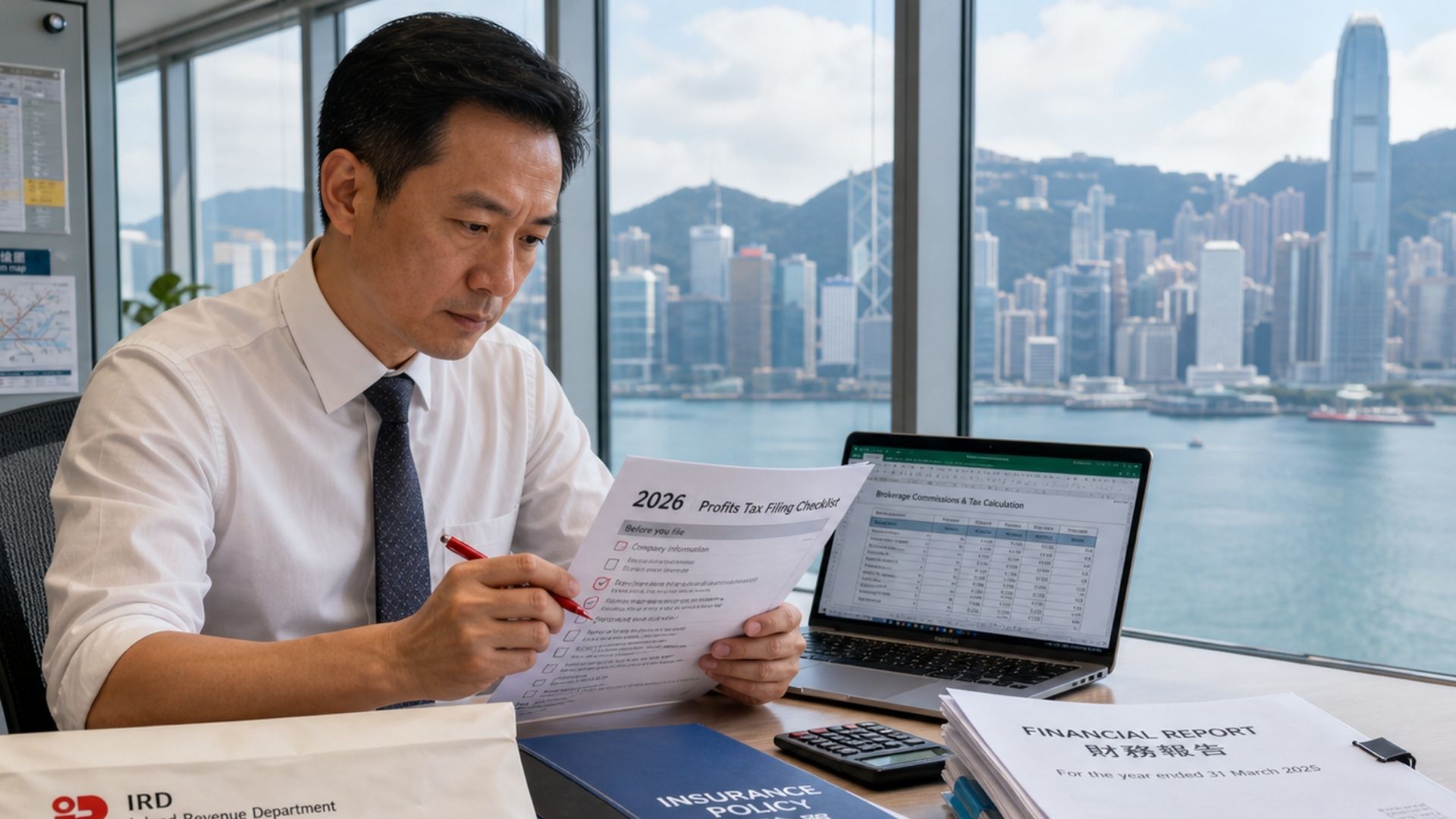
The IRD’s published materials are your baseline roadmap. For insurance brokers, three types of guidance are particularly important:
- The core Profits Tax guidance explaining which expenses are deductible and which are not, including examples of business expenses and non‑deductible personal costs.
- Departmental Interpretation and Practice Notes (DIPNs) such as DIPN 24 on section 16 deductions and DIPN 33 covering tax treatment for insurance agents and similar intermediaries.
- The IRD’s brief guides and pamphlets, which summarise common pitfalls and explain how to compute adjusted assessable profits.
You can access these documents directly on the IRD website (ird.gov.hk), and your HK accountant should also be able to interpret them with practical examples tailored to your brokerage’s business model.
From a day‑to‑day compliance perspective, we encourage insurance brokers to implement a simple internal checklist:
- Document every significant expense with invoices and clear descriptions linking it to your brokerage income.
- Separate personal and business spending by maintaining dedicated business bank and credit card accounts.
- Perform regular reconciliations of commissions, overrides and sub‑agent payments, supported by agreements and statements.
- Prepare clean management accounts and trial balances to support your annual audit and Profits Tax computation.
- Review deductions annually with your HK accountant, especially after major changes, such as moving offices, hiring teams in Cyberport or Kowloon East, or adopting new insurtech platforms.
For many brokers, outsourcing the heavier lifting to an experienced team is more efficient than trying to manage everything in‑house. Pinetree coordinates seamlessly with your statutory auditor via our audit arrangement support and also assists with timely Profits Tax and other tax returns filings so that you avoid penalties and last‑minute surprises.
How Pinetree supports insurance brokers across Hong Kong
Pinetree is based in Tsim Sha Tsui but serves insurance brokers and financial intermediaries across Hong Kong Island, Kowloon and the New Territories, including Central, Quarry Bay, Cyberport, Kwun Tong and Sha Tin. Our team of Hong Kong accountants and experienced accountants have deep familiarity with the day‑to‑day realities of running a brokerage in this city.
We routinely help new broker companies with Hong Kong company formation, corporate secretarial services and, when needed, immigration documentation for licensed responsible officers relocating to Hong Kong via our immigration documentation assistance. From there, we support them with bookkeeping, payroll, MPF administration and tax compliance as they scale.
For more established brokerages, our value lies in tightening financial controls and improving tax efficiency. This includes:
- Designing a chart of accounts that clearly distinguishes deductible and non‑deductible expenses and aligns with IRD expectations.
- Implementing processes around MPF, bonuses, override commissions and TVP/BUD‑funded projects so that subsidies and eligible expenses are captured properly.
- Preparing management information and profitability analysis by product line, distribution channel or district office, helping principals see where their real returns lie.
Because we work closely with statutory auditors and understand the IRD’s approach, we can also help you prepare for potential reviews or audits, ensuring your records and explanations are coherent and defensible.
FAQs on allowable deductions for insurance brokers in Hong Kong
What expenses are fully deductible for insurance brokers in Hong Kong?
In general, expenses that are wholly, exclusively and necessarily incurred to generate your brokerage income are deductible. This includes office rent, staff salaries and commissions, MPF contributions, professional fees to your accounting firm, technology systems used for policy administration and CRM, and reasonable marketing and client education events. The key is to maintain evidence showing the direct business purpose of each cost.
Can I deduct commissions paid to sub‑agents and referrers?
Yes, genuine commissions paid to licensed sub‑agents or referrers are usually deductible, provided they are properly documented. You should have signed agreements, clear commission schedules and records tying each payment to actual business written. Cash payments without documentation or payments to unlicensed individuals will attract IRD scrutiny and may be disallowed.
How should I keep records to support my deductions?
Maintain a disciplined accounting system with clear expense categories, scanned invoices and receipts, and meaningful descriptions for each transaction. Keep separate bank accounts and cards for business, and retain supporting documents such as client lists for marketing events, travel itineraries, conference agendas and internal approvals. Working with a specialist team like Pinetree’s bookkeeping and MIS service helps ensure your records will withstand IRD review.
Do I need an accountant in Central HK, or can everything be done online?
Many insurance brokers prefer to work with an accountant who understands Central HK and the insurance industry but is also comfortable operating online. At Pinetree, we serve clients across Hong Kong using cloud‑based systems, secure document portals and regular video or phone reviews, while still being available for face‑to‑face meetings in Tsim Sha Tsui or near your MTR station when needed. What matters most is that your advisor has strong local tax knowledge and experience with IRD practice in the insurance sector.
If you are an insurance broker or brokerage principal in Central, Tsim Sha Tsui, Kowloon Bay or anywhere else in Hong Kong and would like a clear view of which expenses you can safely deduct, our team is here to help. Contact our Tsim Sha Tsui team today for a free 15‑minute WhatsApp or phone consultation on your accounting, profits tax and compliance needs.