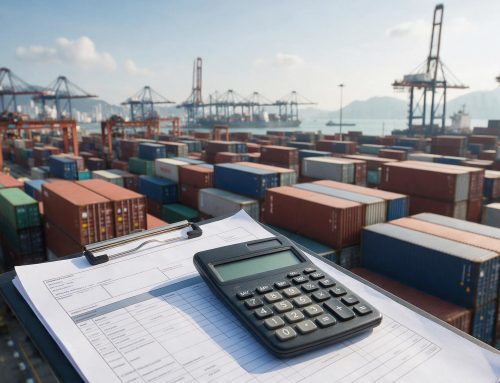

On a typical Monday in Kwai Chung or Sheung Wan, a Hong Kong trading company might pay a Shenzhen supplier in RMB, invoice a US buyer in USD, and still file its annual accounts and profits tax return in HKD. That is the reality for most of the 95,192 import and export trading firms in Hong Kong, the majority of which are small teams handling billions in cross‑border flows.
This guide explains how to run multi‑currency bookkeeping that is both compliant and useful: from HKFRS/IRD rules and functional currency, to practical ledgers, FX gains and losses, bank reconciliation, and the controls that keep margins visible in a volatile FX environment.
Hong Kong trade at a glance: why multi‑currency matters
Hong Kong’s external trade is enormous relative to the size of the local economy:
- In 2024, total exports of goods were about HKD 4,542.4 billion and imports about HKD 4,922.1 billion.
- In 2025, merchandise exports hit a record HKD 5,240.3 billion and imports HKD 5,686.8 billion, both up roughly 15.4–15.5% year‑on‑year.
- The visible trade deficit in 2025 was around HKD 446.6 billion, about 7.9% of import value.
At the firm level, the sector is dominated by SMEs:
- As of December 2024, there were 95,192 import and export trading firms employing about 401,311 people, most with fewer than 10 staff.
- Census and Statistics Department tables show around 69,315 import/export trade companies with total receipts of about HKD 4,523.3 billion and cost of goods sold around HKD 3,618.1 billion in 2024.
Implication: even a 1–2% FX swing across these flows can mean billions in equivalent value at the macro level, and material margin impact for individual traders. Multi‑currency bookkeeping is not a “nice to have”; it is core to understanding true profitability.
The regulatory backbone: HKFRS, HKAS 21 and IRD expectations
Functional currency and HKAS 21
Under Hong Kong Financial Reporting Standards, HKAS 21 governs foreign currency transactions and translation. Two concepts are central:
- Functional currency: the currency of the primary economic environment in which the entity operates.
- Presentation currency: the currency in which financial statements are presented (often HKD for Hong Kong companies).
For an import–export firm, functional currency is determined by economics, not preference. Key indicators include:
- The currency that mainly influences sales prices and cost inputs.
- The currency in which cash is retained and financing is obtained.
A company that buys mainly in USD or RMB and sells in USD may have a functional currency that is effectively USD‑oriented, but still present its statutory accounts in HKD.
Core HKAS 21 mechanics:
- Record foreign currency transactions at the spot exchange rate on the transaction date.
- Translate monetary items (cash, receivables, payables, loans) at the closing rate at each reporting date.
- Recognise exchange differences from settlement or retranslation in profit or loss, unless specific hedge accounting applies.
IRD view: DIPN 42 and average exchange rates
The Inland Revenue Department’s Departmental Interpretation and Practice Notes No. 42 aligns with HKAS 21 for exchange gains and losses:
- Foreign currency transactions should be recorded in the functional currency using the spot rate at the transaction date.
- Foreign currency monetary items should be retranslated using closing rates at each reporting period.
- Exchange differences on settlement or retranslation are normally recognised in profit or loss in the period they arise.
For profits tax, the IRD publishes Average Exchange Rates of Major Foreign Currencies for Profits Tax Purposes on its website. These tables allow businesses to convert foreign‑currency income and expenses into HKD for tax returns, using annual average rates by year of assessment. While your ledger may use daily spot rates, these IRD averages provide a practical reference for tax computations that are consistent with IRD guidance.
The message is clear: regardless of how many currencies you operate in, tax reporting ultimately collapses everything into HKD using IRD‑accepted exchange rates.
What “good” multi‑currency bookkeeping looks like
Below is a practical blueprint tailored to Hong Kong import–export SMEs.
1. Chart of accounts designed for FX
A multi‑currency‑ready chart of accounts typically includes:
- Separate bank accounts per currency (e.g. HKD Current, USD Current, RMB Current).
- Trade receivables and payables by currency (e.g. Trade Debtors – USD, Trade Creditors – RMB).
- Clear FX gain/loss accounts, split if possible into:
- Realised FX gain/loss (on settlement).
- Unrealised FX gain/loss (period‑end revaluation).
- Cost centres or tags for product lines, routes, or key customers, so you can see FX impact by segment.
This structure makes it possible to run aged AR/AP reports by currency, which is critical when you are negotiating payment terms or assessing exposure.
2. Recording transactions correctly
For each type of transaction, the mechanics are similar but must be consistent:
Supplier invoices (foreign currency)
- Record the invoice at its face value in the supplier’s currency.
- Book the expense (or inventory) and the payable in HKD at the transaction‑date spot rate.
- On payment, convert the amount paid at the actual bank rate, and post the difference to realised FX gain/loss.
Customer invoices (foreign currency)
- Issue the invoice in the customer’s currency.
- Recognise revenue in HKD at the transaction‑date spot rate.
- Hold the receivable in the foreign currency in the ledger.
- On receipt, book any difference between the HKD value at receipt and the original HKD value as realised FX gain/loss, not as an adjustment to revenue.
Bank transfers and conversions
- When converting between currencies (e.g. USD to HKD), record:
- The gross amount in the source currency.
- The net amount received in the target currency.
- The bank’s spread/fee as a separate expense or within FX loss, depending on your policy.
Consistent treatment ensures that your gross margin reflects trading performance, while FX effects are visible but not hidden inside COGS or revenue.
3. Bank reconciliation in native currency
A common mistake is reconciling only the HKD equivalent of a foreign‑currency bank account. Best practice:
- Maintain the bank ledger in the foreign currency (e.g. USD).
- Reconcile the foreign‑currency ledger balance to the bank statement in that same currency.
- Let the system or your process handle the HKD translation separately for reporting.
This avoids masking true reconciling items (e.g. unpresented cheques, timing differences) inside FX translation noise.
4. Period‑end revaluation and reporting
At each month‑end or year‑end:
- Revalue all foreign‑currency monetary items (cash, receivables, payables, loans) at the closing rate.
- Post the resulting unrealised FX gain/loss to profit or loss.
- Produce:
- A trial balance in HKD for statutory reporting.
- Supplementary reports by currency (aged AR/AP, cash by currency, exposure summary).
This gives you both compliant HKD financials and the operational visibility needed to manage FX risk.
Hong Kong import–export sector metrics you can benchmark against
These figures help you contextualise your own numbers and explain why tight bookkeeping matters.
| Indicator (Import/Export Trade, 2024) | Value (HKD million) | Why it matters for bookkeeping |
| Number of companies | 69,315 | Highly competitive, many small players. |
| Persons engaged | 351,090 | Small teams handling large flows. |
| Compensation of employees | 155,878 | Labour cost baseline in HKD. |
| Operating expenses (excl. COGS) | 318,555 | Overheads sensitive to FX on services, logistics. |
| Cost of goods sold | 3,618,065 | Often in USD/RMB; major FX exposure. |
| Total receipts | 4,523,278 | Revenue across multiple currencies. |
| Gross surplus | 430,781 | Rough gross profit; FX can erode this quickly. |
| Value added | 493,288 | Sector contribution to GDP; highlights macro importance. |
If your firm’s margins are in the same ballpark as the sector’s aggregate gross surplus ratio, even modest FX mis‑bookings or unmanaged exposures can wipe out a meaningful slice of profit.
FX risk is a bookkeeping issue as much as a treasury issue
Hong Kong banks and regulators emphasise that foreign exchange risk arises whenever:
- Invoices, receipts, loans, investments or remittances are denominated in foreign currencies.
- Profits earned overseas are converted into HKD, or obligations are settled in foreign currencies.
Major banks’ SME guidance and HKMA supervisory material highlight typical risk drivers:
- Import or export invoices quoted in foreign currencies.
- Foreign‑currency loans used for trade finance or working capital.
- Overseas investments and profit repatriation in foreign currencies.
- Converting foreign profits to HKD and settling obligations in foreign currencies.
Each of these creates monetary items on the balance sheet that must be retranslated at closing rates under HKAS 21, with exchange differences flowing through profit or loss unless specific hedge accounting is used.
At SME scale, you do not need a full treasury desk, but you do need:
- A clear FX policy (which currencies you accept, standard payment terms, when you hedge).
- Simple limits (maximum open FX exposure by currency, maximum days of uncovered receivables).
- Regular reports (cash and net working capital by currency, realised and unrealised FX by month).
Your bookkeeping system should be the source of truth for all of these.
Software and systems: what to look for
Many Hong Kong SMEs struggle with multi‑currency because their software only allows pricing in different currencies without proper accounting entries. A robust solution for an import–export business should support:
- Transaction‑date rate capture for every invoice and payment.
- Automatic realised FX postings on settlement.
- Automatic unrealised FX revaluation at period‑end.
- Separate bank accounts per currency, with reconciliation in the native currency.
- Multi‑currency invoicing with HKD revenue recognition.
- Aged AR/AP reports by currency and exposure dashboards.
- HKFRS‑compliant reporting, bilingual documents, and hooks for local compliance (e.g. MPF, IR56, profits tax).
Some global platforms used in Hong Kong advertise support for invoicing and payments in 160+ currencies, with automated conversions and frequent exchange‑rate updates. Newer AI‑native accounting platforms targeting Hong Kong highlight “true multi‑currency books” with real‑time revaluation of HKD, USD, CNY and other balances, aimed at consolidating multi‑entity structures without spreadsheets.
The goal is not to chase the most complex system, but to ensure your tooling matches the complexity of your trade flows.
A practical month‑end checklist for multi‑currency traders
Use this as a starting point and adapt to your size and systems.
Before month‑end close:
- Ensure all foreign‑currency bank statements are received.
- Confirm all supplier invoices and customer invoices in foreign currencies are recorded at correct transaction‑date rates.
- Verify that all payments and receipts in foreign currencies are matched to the correct invoices.
At month‑end:
- Reconcile each foreign‑currency bank account in its native currency.
- Run aged AR and AP reports by currency and review large or old items.
- Perform period‑end revaluation of all foreign‑currency monetary items at closing rates.
- Review realised and unrealised FX gain/loss by currency and by major customer/supplier.
- Produce a simple FX exposure summary (net position by currency, in HKD equivalent).
For management reporting:
- Prepare a currency‑split P&L (e.g. USD trades vs RMB trades vs HKD trades) if volumes justify it.
- Track gross margin by route or product line, ensuring FX is not hidden inside COGS or revenue.
- Compare budgeted vs actual FX rates used, to understand how much variance is due to pricing vs FX.
This discipline turns multi‑currency bookkeeping from a compliance burden into a decision‑support tool.

Common pitfalls (and how to avoid them)
- Mixing realised and unrealised FX
Some systems or spreadsheets lump all FX into one account. Over time, you lose visibility into what is “locked in” versus what is still exposed.
Fix: separate accounts and report them separately in management packs. - Reconciling only HKD equivalents
Reconciling the HKD translation of a USD account can hide timing differences and errors.
Fix: reconcile in the native currency first, then review HKD translation separately. - Adjusting revenue for FX on settlement
Booking FX differences as revenue adjustments distorts pricing analysis.
Fix: keep revenue at the original HKD value; post settlement differences to realised FX. - Ignoring bank spreads and fees
Treating all conversion differences as “market FX” can mask costly bank pricing.
Fix: separate bank fees/spreads from pure FX rate movements where possible. - No currency view of working capital
Looking only at total AR/AP in HKD can hide concentration risk in one currency.
Fix: always review aged AR/AP and cash by currency.
Where Pinetree fits: practical support, not just compliance
For many Hong Kong trading companies, the ideal setup is a combination of:
- A solid multi‑currency accounting system (cloud or on‑premise).
- A bookkeeping process that consistently applies the rules above.
- An advisor who understands HKFRS, IRD practice, and the realities of import–export trade.
Our team regularly works with import–export SMEs on:
- Designing charts of accounts and workflows that handle multi‑currency bank accounts, AR/AP, and FX postings cleanly.
- Performing or reviewing month‑end bookkeeping, including bank reconciliations and period‑end revaluations.
- Preparing HKFRS‑compliant financial statements and supporting documentation for auditors.
- Aligning profits tax computations with IRD expectations, including the use of IRD average exchange rates where appropriate.
If you are setting up a new trading entity, our colleagues can also assist with company formation, ongoing corporate secretarial services, and audit arrangement so that your books, statutory filings, and tax returns are aligned from day one. For businesses that are scaling and hiring, we can integrate payroll services into the same reporting framework, and for founders and key staff relocating to Hong Kong, support is available for assistance in immigration documentation.
The aim is not to sell you a bundle of services, but to ensure that your multi‑currency bookkeeping actually helps you see and manage risk, rather than just ticking a compliance box. You can read more about our core bookkeeping and accounting services and how they are structured for trading companies, and about our tax returns support for profits tax and related filings.
FAQ: multi‑currency bookkeeping for HK import–export firms
What is the best way to choose functional currency for a Hong Kong trading company?
Look at the currency that mainly drives your sales prices, cost inputs, and cash retention. If most of your contracts, costs and cash balances are in USD, your functional currency may effectively be USD even if you present accounts in HKD. Document your reasoning and apply it consistently.
Do I have to use IRD average exchange rates in my books?
No. Your ledger can use daily spot rates for transactions and closing rates for period‑end revaluation. IRD average exchange rates are primarily for profits tax computations, where they provide an accepted way to convert foreign‑currency income and expenses into HKD.
How should FX gains and losses be presented in management reports?
Separate realised (on settlement) and unrealised (on revaluation) FX, and consider showing them:
- As a distinct line below operating profit.
- Split by currency and by major customer/supplier where material.
This keeps trading performance visible while still highlighting FX impact.
Is multi‑currency bookkeeping really necessary for a small trading firm?
If you invoice or pay in more than one currency, yes. With Hong Kong’s 95,000+ import–export firms mostly being small teams, the difference between “getting by” and having clear numbers often comes down to disciplined multi‑currency bookkeeping. It is the foundation for reliable margins, cash‑flow forecasts, and credible financial statements for banks and investors.
If you run an import–export business in Central, Tsim Sha Tsui, Kwai Chung or anywhere else in Hong Kong and want to review how your current bookkeeping handles multi‑currency transactions, FX gains/losses, and IRD/HKFRS requirements, our team is happy to help. Contact our Central HK team for a free 15‑minute WhatsApp or phone consultation to discuss your accounting, bookkeeping and tax needs.